The method in a nutshell
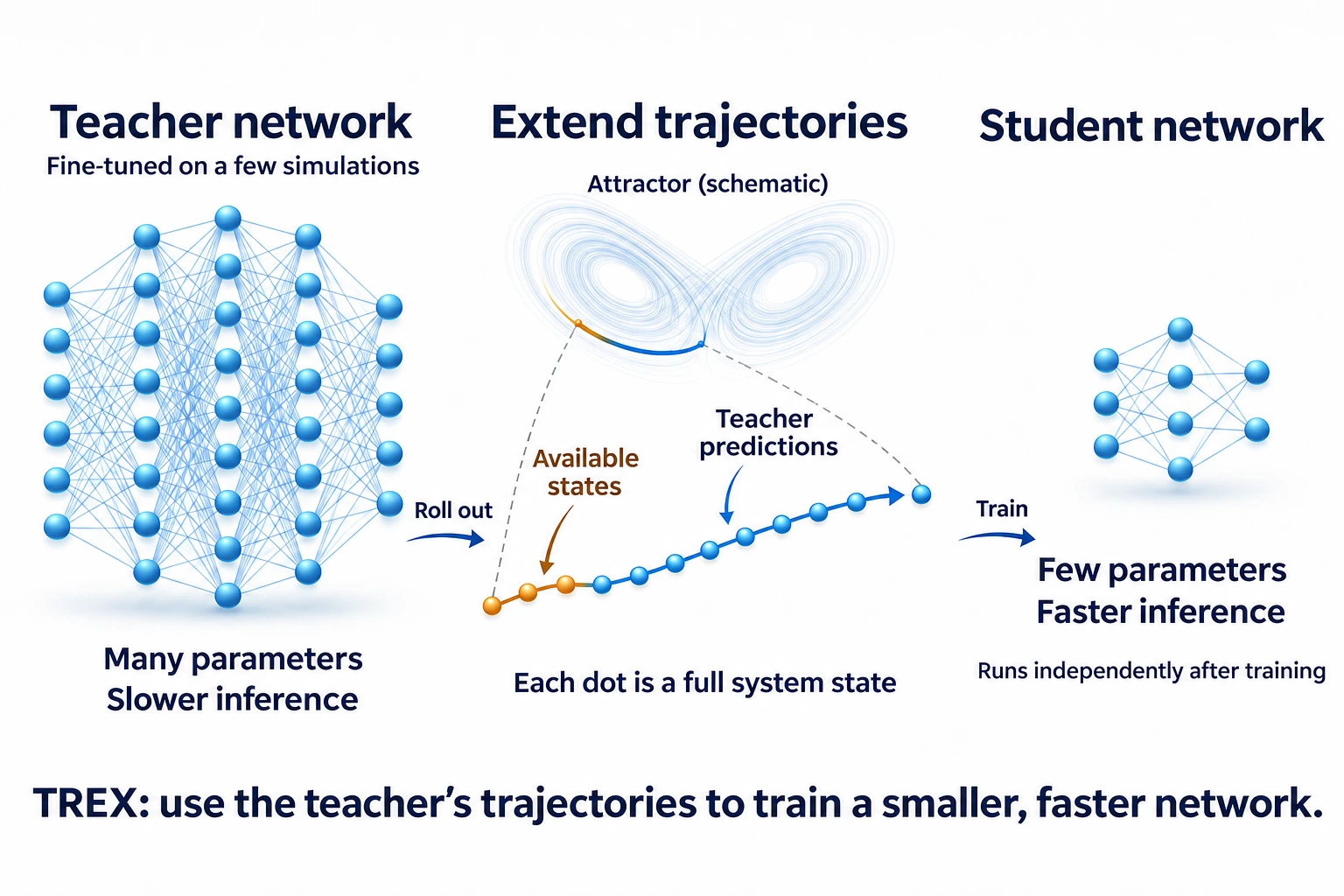
A large foundation model can learn to predict evolving physical systems from just a few simulations. But running that model can still be expensive.
Teacher Rollout Extension (TREX) turns it into a teacher. After fine-tuning, the teacher repeatedly predicts later states, extending the available simulations into longer training examples. Optional noise exposes the student to perturbed states and the teacher’s recovery.
A compact student learns from this richer data and can incorporate physical symmetries. TREX needs no sampler for new initial conditions: it starts with the examples already available.
The payoff: in the paper’s PDE benchmarks, students can match or surpass the teacher’s accuracy with over 10× faster inference and orders of magnitude fewer parameters.
Distillation of Foundation Models for Time-dependent PDEs. NeurIPS 2026. Publication record